Windows Setup
Applies to Windows, AndroidWritten for Titanium SDK 13.4.0 and later
Run the commands below in PowerShell.
Install Node.js
Titanium requires Node.js 22.19.0 or 24.x.
Important
Node 26 is only compatible with Titanium SDK 14 or newer. Node 24 works with every SDK.
winget install OpenJS.NodeJS.LTS.LTS follows whatever is LTS at the time, so confirm the version below.
winget install CoreyButler.NVMforWindowsReopen PowerShell as Administrator, then:
nvm install 24
nvm use 24
Download the .msi from nodejs.org.
node -vInstall a JDK
Titanium requires JDK 17, 21, or 25. JDK 26 is only compatible with Titanium SDK 14 or newer. Any distribution works. The commands below install Temurin or your distribution's OpenJDK.
winget install EclipseAdoptium.Temurin.21.JDKDownload the .msi from
Adoptium.
javac -versionSet JAVA_HOME
Gradle and the Titanium SDK locate the JDK through JAVA_HOME. Most installers
leave it unset.
[Environment]::SetEnvironmentVariable(
  'JAVA_HOME',
  (Get-Item (Get-Command javac).Source).Directory.Parent.FullName,
  'User'
)
Reopen PowerShell, then:
& "$env:JAVA_HOME\bin\javac" -versionInstall the Titanium CLI
npm install -g titaniumpnpm add -g titaniumti -vThe command is also available as titanium:
titanium -vInstall the Titanium SDK
The CLI is the tool you run; the SDK is what builds your app. You can have several SDKs installed at once.
ti sdk installWith no version, that installs the latest stable release and makes it the default. It is a few hundred megabytes.
ti sdk list
ti sdk list --releases
Install the Android SDK
Titanium needs four pieces of it:
| Component | Why | Supported by SDK 13.4 |
|---|---|---|
| SDK Platform | Compiles against it | API 23 to 36 |
| Build Tools | Packages the APK | 30.0.2 to 35.x |
| Platform Tools | Provides adb |
33.x |
| Emulator | Runs a virtual device | Any current version |
Android Studio is the straightforward way to get them. The command-line tools are smaller and are what you want on a build server.
Install Android Studio and let the setup wizard run. It installs a platform, build tools and platform tools.
Then open Settings → Languages & Frameworks → Android SDK and check that SDK Tools lists Android SDK Build-Tools, Android SDK Platform-Tools and Android Emulator.
Download the command-line tools from the
Android Studio downloads page
and unzip them to <sdk>/cmdline-tools/latest. The tools expect that exact
layout and fail confusingly without it.
sdkmanager "platforms;android-36" "build-tools;35.0.0" "platform-tools" "emulator"Note
Google has deprecated sdkmanager in favour of android sdk install platforms/android-36 build-tools/35.0.0. Both work. sdkmanager still ships
in the command-line tools and is what most CI scripts call.
Set the Android SDK path
ti setup androidti setup android finds the SDK and writes the path to the CLI's config, so no
environment variable has to be right.
If you would rather set one, Titanium checks ANDROID_SDK_ROOT and
ANDROID_SDK, then looks for adb on your PATH, then scans the usual install
directories.
Important
ANDROID_HOME is not one of them. Most Android documentation tells you to set
it; Titanium's app build does not read it.
Versions newer than Titanium supports
Google ships API levels and build tools faster than the SDK adds support, so a current Android Studio usually produces warnings:
!  Android API Android 17 (android-37) is too new and may or may not work with
   Titanium SDK 13.4.0.
   The maximum supported Android API level by Titanium SDK 13.4.0 is API level 36.
Titanium builds anyway. Leave them until a build fails, then pin a version it knows:
ti config android.buildTools.selectedVersion 35.0.0Android Studio installs the SDK to %LOCALAPPDATA%\Android\Sdk, which the CLI
already checks.
Important
Do not put the SDK anywhere with a space or an ampersand in the path. Titanium
checks for ampersands and refuses to build, because the Android build tools
mis-parse them. That rules out C:\Program Files.
Set up an emulator
The emulator needs hardware acceleration: either Windows Hypervisor Platform or Intel HAXM. Android Studio's setup wizard enables whichever applies.
If it will not start, enable Windows Hypervisor Platform in Turn Windows features on or off, reboot, and try again.
A physical device over USB is faster. It needs USB debugging turned on in Developer options and the vendor's USB driver.
Verify Titanium is Ready
ti info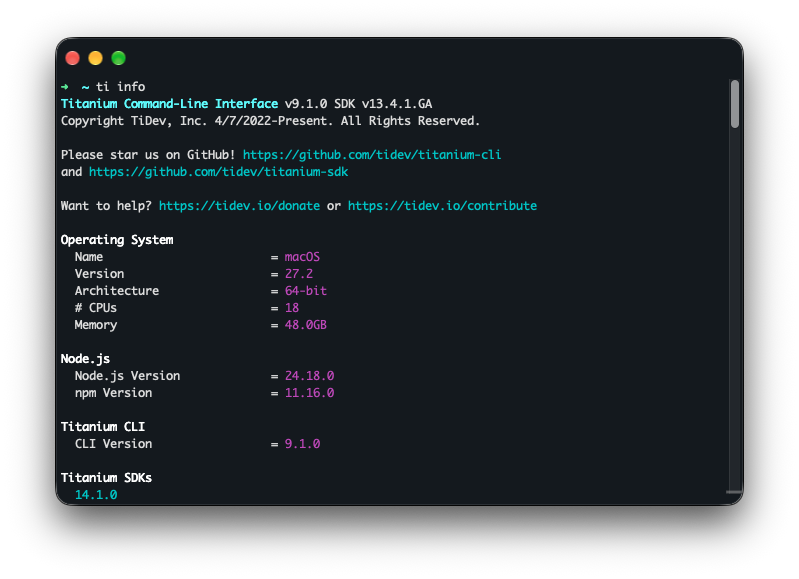
ti info lists everything it detected and any issues it found. A working setup
reports none.
Warnings are common and usually harmless: a component newer than the SDK
supports produces one, and so does a missing NDK. When something is wrong,
ti info names it and says what to do.
Troubleshooting
ti is not recognised as a command
Reopen PowerShell. A fresh install does not affect a shell that was already
running. If it still fails, check that npm's global directory is on your PATH:
npm config get prefixti info cannot find the Android SDK
Run ti setup android and give it the path. If you set ANDROID_HOME and
expected it to work, use ANDROID_SDK_ROOT instead.
The build fails complaining about the SDK path
Check the path for spaces and ampersands. Moving the SDK is the only fix.
A build fails partway through with a file-in-use error
Antivirus scanning the build directory. Exclude your project's build
directory from real-time scanning.
Next
Your first app creates a project and builds it.